~~ Tourette's Syndrome ~~
Tourette's just makes me feel different sometimes. And that's hard when it's all about fitting in. I don't want to be an outcast from everybody.
Being different is never easy. At one time I was afraid of being different. It meant that people might turn away from me (rejection) or call me all kinds of names or even hurt me (danger).
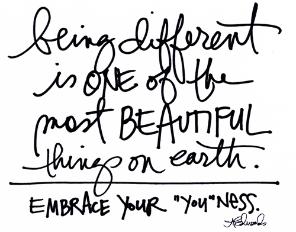 Whoever has tics will be a person still. It's not like you're bad or anything, don't know anything. You're still a human even though you have Tourette's. I have Tourette's Syndrome. My daughter also, has Tourette's. TS is a neurological disorder that becomes evident in early childhood or adolescence that is defined by multiple motor and vocal tics. The first symptoms are usually involuntary movements (tics) of the face, arms, and limbs. These tics are frequent, repetitive and rapid. The most common first symptom is a facial tic (eye blink, nose twitch, grimace), and is replaced or added to by other tics of the neck and limbs. Some involuntary tics may be complicated - involving the entire body - such as kicking and stamping. When I have an involuntary complicated tic, it feels as if I have the urge to perform a motor activity. Other Tourette's symptoms such as touching, repetitive thoughts and movements, and compulsions happen too. Tourette's also comes with verbal tics. These vocalizations include grunting, throat clearing, shouting and barking. The verbal tics may also be expressed with the involuntary use of obscene words or obscene gestures. Despite what you hear, this is UNCOMMON. Now, I am going to tell you how TS affects me. For as long as I can remember, I've had tics. At 43, I'm able to hide these things from most people. If you spend enough time with me, you might see me twitch or hear me grunt and not realize what I am doing. When I'm really stressed or extremely uncomfortable with my surroundings, my tics, get worse. When I am with my family I do it freely - I don't try to cover it up. They act like there's nothing wrong - they don't even acknowledge I'm doing it. When I'm somewhere that I need to hide it, the tension builds. It actually hurts when I try to hold the tics in. When I finally am able to release them, it takes a while for them to stop. Television and other media outlets make it out that it's humorous or make TS look like it's an awful disease. When I told someone I had Tourette's, they actually asked, “When are you going to start cursing and throwing things?" I really wish people would take the time to learn about TS and stop saying ignorant things. My symptoms aren't as bad as others. My family accepts me for the way I am. There was a guy on American Idol this past season who had TS. When I saw him twitch on TV without a care in the world, it gave me hope. The most important thing I have learned is this: I have Tourette’s Syndrome. Tourette’s Syndrome doesn't have me. ************************************************************************ Tics are... like an itch, like you have to, like scratch it. You just... do it. It's like controlling you, and you feel like you have to do it or something's going to happen. The effect Tourette's syndrome has on a child's life varies. Having tics does not affect a child's intelligence, but the condition may interfere with learning. The severity of the tics is not a good indicator of how well a child tics will do in school or social situations. The child's intelligence, ability to adjust to change and support from other people affect how well the child will cope. The course of Tourette's syndrome usually has a predictable pattern. By age 10 or 11 years, a child with tics may be able to tell when one is starting. The child may feel muscle tightness, a skin irritation (such as a tickle) or a skin temperature change. At this age, a child's tics may start to become severe. During the teen years, tics usually are severe. Tics usually decrease during the 20s, and they may get worse again during the 30s or 40s.
| History: Tourette syndrome (TS) is a neurological disorder characterized by repetitive, stereotyped, involuntary movements and vocalizations called tics. The disorder is named for Dr. Georges Gilles de la Tourette, the pioneering French neurologist who in 1885 first described the condition in an 86-year-old French noblewoman. The early symptoms of TS are typically noticed first in childhood, with the average onset between the ages of 3 and 9 years. TS occurs in people from all ethnic groups; males are affected about three to four times more often than females. It is estimated that 200,000 Americans have the most severe form of TS, and as many as one in 100 exhibit milder and less complex symptoms such as chronic motor or vocal tics. Although TS can be a chronic condition with symptoms lasting a lifetime, most people with the condition experience their worst tic symptoms in their early teens, with improvement occurring in the late teens and continuing into adulthood. Educational: The exact cause of Tourette's is unknown, but it is well established that both genetic and environmental factors are involved. Genetic studies have proved that the overwhelming majority of cases of Tourette's are inherited, although the exact mode of inheritance is not yet known,and no gene has been identified. Tics are believed to result from dysfunction in the thalamus, basal ganglia, and frontal cortex of the brain, involving abnormal activity of the brain chemical, or neurotransmitter, dopamine. Non-genetic factors—while not causing Tourette's—can influence the severity of the disorder. Some forms of Tourette's may be genetically linked to OCD, while the relationship between Tourette's and ADHD) is not yet fully understood. A person with Tourette syndrome has about a 50% chance of passing the gene(s) to one of his/her children. Gender appears to have a role in the expression of the genetic vulnerability, with males more likely to express tics than females. Tourette syndrome is a condition of incomplete penetrance, meaning not everyone who inherits the genetic vulnerability will show symptoms. Tourette's also shows variable expression—even family members with the same genetic makeup may show different levels of symptom severity. The gene(s) may express as Tourette syndrome, as a milder tic disorder (transient or chronic tics), or as obsessive compulsive symptoms with no tics at all. Knowing what I know now.
I had the hope as I was told at one point in time, that some people with TS out grow their symptoms as they get older. Unfortunately for that has not been the case. It appears that once I hit my 40's my symptoms reverted back to my teens. It's difficult to know that the time came when I did not want to leave my house, i felt like I could perform my job to the best of my ability and I hid for as long as i could. Thank fully, I have a husband and children who noticed that Mom was struggling, even to the point of suffering. So, back to the doctor I went (again). It is never easy hearing each time that most practitioners do not see many adults with Tourettes Syndrome and the treatment between children with TS and adults, well for adults can be more complex. But, I have a very understanding doctor, one who has spent hours with me and just talking and re examining the issues of the chemical make up in my brain. Unfortunately, I have no way of tracing through my lineage as to where the inheriting of an extra chromosome, or neurological chemical went wrong, I can only speculate, but knowing that it is hereditary, because one of my daughters has TS can make it easier for some families to track down the link. Of course their were blood tests and other tests to rule out tumors and such as I have gone through before, just as a precautionary measure.....thank GOD. So, how do I deal with it???? It's like this, it is hard especially at 43 when I find myself being teased or mocked behind my back....still stings like it did when I was a kid. I remember one day being and church and my Mom told my to pray about it....pray that God will take it away from you. I sat there and wanted to say "That's all that I do...all I do is pray" trust me that is not the kind of attention was ever seeking. |

